




Stelter’s Senior Gift Planning Consultant, Lynn M. Gaumer, J.D., CAP®, offers her analysis of how and where Americans gave last year as reported in Giving USA 2026: The Annual Report on Philanthropy for the Year 2025.
Charitable giving reached a record $617.20 billion (in current dollars) in 2025, according to the just-released Giving USA report. That startling number tells a simple story of American generosity. But a closer look reveals how many factors influence how and where Americans give.
For fundraisers, the real value of the report is not just in the topline number—it is in understanding what the data says about donor behavior today and how organizations can respond in the months and years ahead.
This year’s findings offer both reassurance and perspective. Giving continues to grow, but the sources and destinations of charitable dollars are shifting. To make sense of those changes, we’ll look at who gave, where the dollars went, what long-term trends are emerging and what fundraisers can do now to navigate the latter half of this year.
The Big Picture
The new numbers show that individual donations, corporate donations, bequests and foundation giving added up to $617.20 billion in 2025. That’s a 5.7% increase in current dollars (3% when adjusted for inflation) over 2024.
That’s more than $1.69 billion every single day.
If you combine the individual and bequest numbers, individuals contributed 74% of all dollars given to charity in 2025. This is a key number to use when trying to make your case to start or expand a planned giving program at your organization.
Who Is Giving?
Individuals remain the primary source of charitable giving. They gave $394.20 billion in 2025 and represented 64% of all charitable giving. That’s a 4.1% increase over the previous year but just 1.4% when adjusted for inflation. With strong financial markets, we might have expected to see higher growth here, but consumer sentiment reached near historic lows in 2025 and may have dampened giving by some households. Even so, individual giving still posted growth, underscoring the resilience of donors amid mixed economic signals. Contributions included gifts of cash, securities and property.
Giving by foundations is growing, amounting to $117.15 billion—19% of all contributions made in 2025. That’s a 5.7% increase over the previous year (3% when adjusted for inflation). Giving by foundations crossed the $100 billion mark for the fourth consecutive year, fueled primarily by market growth. Foundation giving has grown each of the last 15 years.
More than $62.19 billion was given via bequests, an increase of a staggering 19.7% from 2024 (16.6% when adjusted for inflation). These gifts are the most volatile form of giving. The yearly total tends to fluctuate based on the estates of high-net-worth donors and is less influenced by economic factors. But we have seen continued growth year over year. In three of the last four years, bequest giving saw 20+% growth (in current dollars). You should continue to promote gifts in wills and trusts, as they provide a solid foundation for any planned giving program.
The data shows that corporate giving hit a record level and increased 3.1% from 2024 (a flat 0.5% when adjusted for inflation) and represented just over $43.67 billion. Although corporate giving was a little weaker in 2025, it has grown the most among any sources in the last four years. A large growth of in-kind pharmaceutical donations has likely contributed to this growth. Corporate giving includes cash and in-kind contributions made through corporate giving programs as well as grants and gifts made by corporate foundations.
Where Are Charitable Dollars Going?
Giving grew in eight of the nine major recipient subsectors (with five reaching all-time highs).
Three sectors not only saw double-digit growth in current dollars in 2025 but had the largest annualized rates of change in the last five years:
- Education led the way in 2025, growing by 11.7% to $92.01 billion (8.9% when adjusted for inflation), an all-time high.
- Public-society benefit grew by 11.6% to $72.06 billion (8.7% when adjusted for inflation). This sector includes a wide range of organizations, including national donor advised funds (DAFs) such as Fidelity and Vanguard Charitable. This may account for the growth in this sector.
- Environment and animal organizations grew by 11% to $24.57 billion (8.2% when adjusted for inflation), its most ever.
Four sectors saw single-digit growth in current dollars, even when adjusted for inflation:
- Arts, culture and humanities grew by 7.5% to $27.31 billion (4.7% when adjusted for inflation), an all-time high.
- Health grew by 6.1% to $61.43 billion (3.3% when adjusted for inflation), its highest amount ever.
- Human services grew by 5.3% to $99.50 billion (2.6% when adjusted for inflation), the most this category has seen.
- International affairs grew by 4.1% to $33.02 billion (1.4% when adjusted for inflation).
Giving to foundations decreased by 16.2% to $79.05 billion (a decrease of 18.3% when adjusted for inflation). But it was coming off a strong year in 2024 and remains well above pre-pandemic highs.
Only one sector grew but did not outpace inflation: Religion grew by 2.4% to $151.58 billion but was minus 0.2% when adjusted for inflation. Since 2005, religious giving has only grown 1% when adjusting for inflation. However, this sector still received the largest share of charitable dollars at 23% of total giving.
Get the Report
To learn more about the sources and uses of charitable donations this past year, read the Lilly Family School of Philanthropy press release or get the full report by subscribing to Giving USA.
Take a closer look at who gave and where the dollars went in our infographic below, then download the PDF to refer to later.


A Look Back: Reflecting on American Philanthropy
Comparing these figures to past years reveals a compelling narrative. Over the past decade, we’ve seen fluctuations in giving patterns influenced by factors such as tax policy, the economy, a pandemic, natural disasters and shifts in social priorities. First, let’s compare the sources of giving over a 40-year period and see whether any trends emerge.

Giving Sources: Key Takeaways
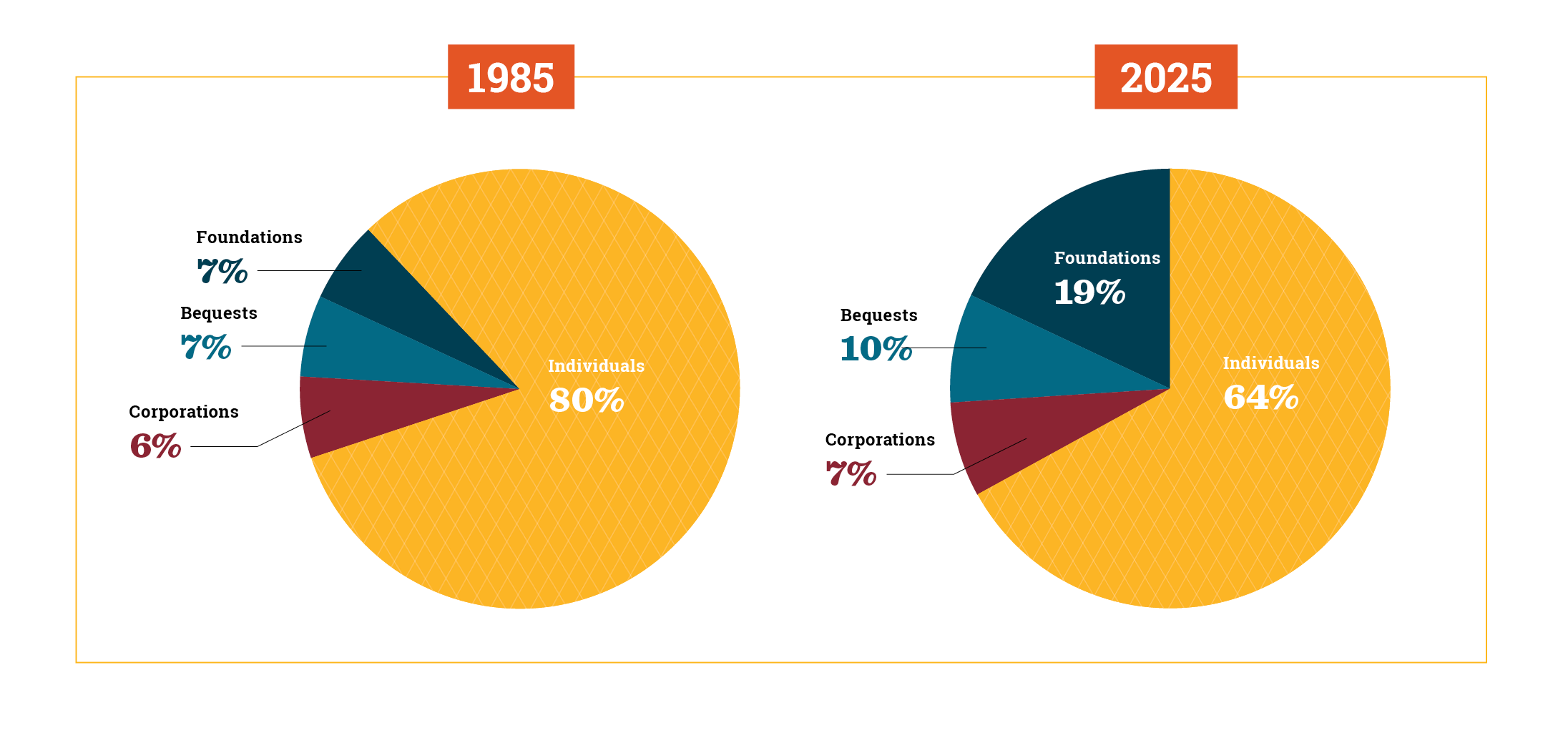
Giving by individuals is shrinking as a share of giving over the last 40 years, from about 80% in 1985 to 64% in 2025.
Several factors are driving this shift:
- Tax policy, economic uncertainty, inflation and concerns about personal financial stability may be causing households to pull back on charitable contributions.
- Additionally, the higher standard deduction under the Tax Cuts and Jobs Act of 2017 (made permanent under the most recent tax reform) reduced the number of taxpayers who itemize—and with it, the tax incentive to give.
- Generational shifts also play a role: Younger donors expect transparency and tend to give differently, often prioritizing direct action and community involvement over traditional nonprofit structures.
- Finally, a growing concentration of giving among high-net-worth individuals may be masking a broader disengagement among everyday donors.
To reverse this trend, organizations need to invest in retention, recurring giving and personalized engagement. One way to start is by using the new universal charitable deduction as an entryway.
According to Giving USA, charitable bequests have consistently represented between 7% and 9% of total giving in the United States over the past four decades—a testament to the enduring role of gifts in a will in philanthropy. Last year, bequest giving represented 10% of total giving. In 2025 alone, bequest giving totaled an estimated $62.19 billion. While annual totals can fluctuate due to estate settlement timing, the long-term stability of bequest giving highlights how planned gifts remain a vital and reliable source of support for nonprofits. This steady presence underscores the importance of highlighting bequests through multichannel marketing and legacy conversations with donors; many people choose to make the most significant gifts of their lives through their estate plans.
Not only did giving by foundations experience another year of growth over the last year, but its share of giving has surged from about 7% in 1985 to 19% in 2025. This category covers grants made by independent, community and private foundations. The increase can be attributed in part to steady asset growth. According to the latest report by Foundation Mark, U.S. foundations’ assets rose by about $150 billion (about 9.1%) in 2025, pushing assets to a record $1.786 trillion. Build relationships with your local community foundations. Diversify your funding with private foundations.
Now let’s examine giving sectors over a 40-year period.

Giving Sectors: Key Takeaways
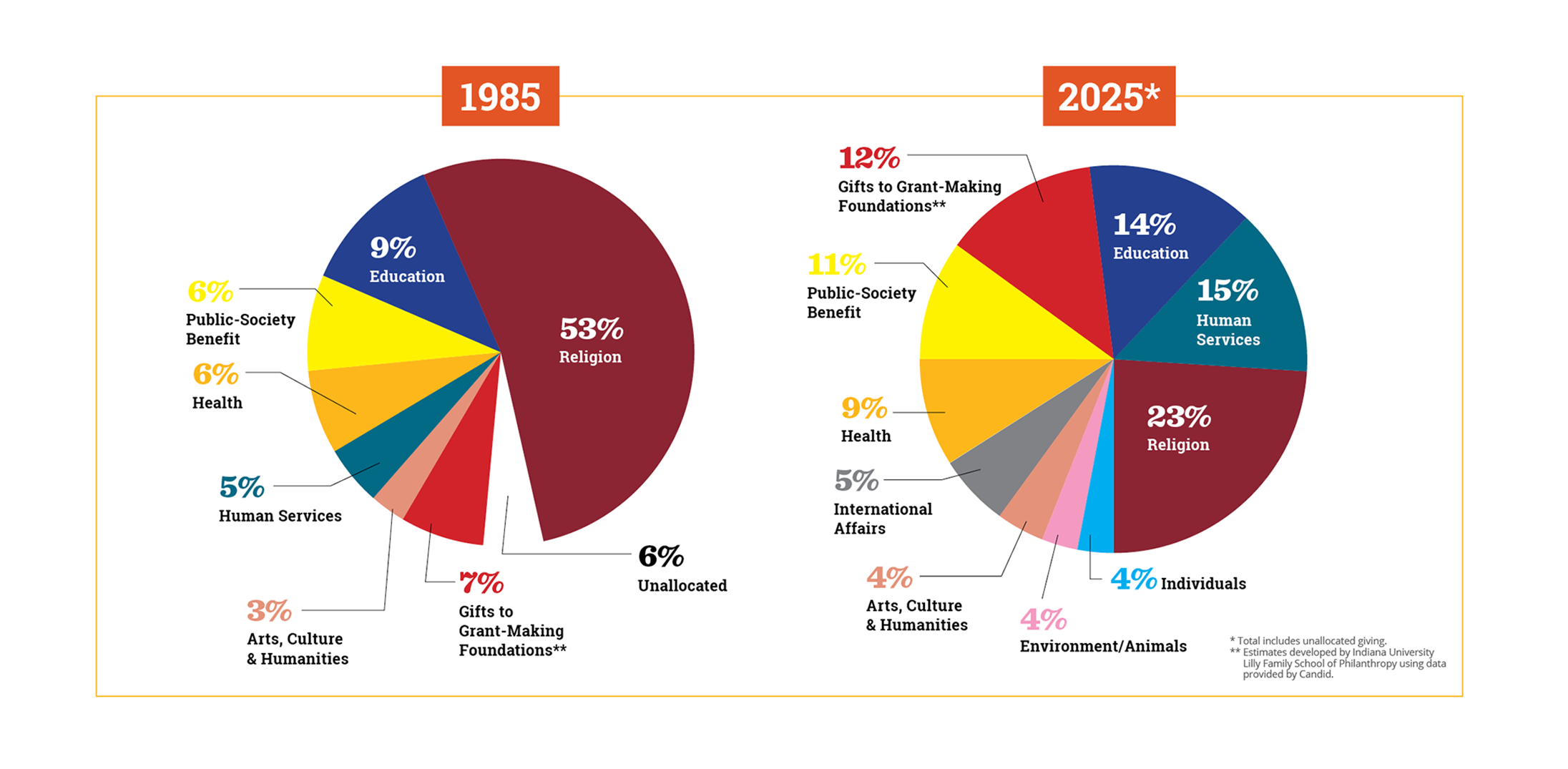
Religion continues to receive the largest share of charitable dollars, totaling an estimated $151.58 billion in 2025. However, religion’s overall share of total giving has steadily declined over time—from 53% in 1985 to just 23% in 2025. But that may be starting to change. A report from Hartford Institute for Religion Research (pdf download) shows that for the first time in two decades, church attendance is up. There is a renewed sense of optimism among pastors and other clergy. Data shows that the percentage of givers who donate to religion mirrors the number of people who report church membership.
Notably, while DAF donors support a wide variety of causes, religious organizations remain among the most supported. Fidelity Charitable’s Geography of Giving (pdf download) report that 50% of its donors recommend at least one grant to a religious house of worship, underscoring that faith-motivated giving is still strong—though increasingly channeled through more flexible giving vehicles like DAFs rather than traditional weekly offerings. And if you look at the Fidelity 2026 Giving Report (pdf download), religion receives the highest percentage of DAF grants compared to any other charitable sector. These organizations should promote DAFs in their promotional material.
Good news for giving in the education sector. Not only was education one of the sectors that reached its all-time high in 2025 (even when adjusted for inflation), but its share of giving has increased from about 9% to 14% over the last 40 years. And according to the Fidelity 2026 Giving Report, education received the highest percentage of DAF grant dollars among all sectors.
The human services sector has also seen considerable growth. Over the past 40 years, it has risen from just 5% of all charitable giving to 15%. Philanthropic support continues for community support programs, racial justice, food insecurity, affordable housing and many other important causes as demand increases. In addition, online growth has helped human services organizations build their donor base and deepen their pool of major and planned gift donors.
Giving to the health sector reached an estimated $61.43 billion in 2025, growing from about 6% in 1985 to 9% of all charitable giving. The sector has benefited from increased donor interest in medical research, patient care, mental health and pandemic-related needs. Aging baby boomers and personal experiences with illness have also driven legacy giving to hospitals and health foundations. DAFs continue to play a key role, underscoring the sector’s relevance in both immediate and long-term philanthropic planning.
A Look Ahead: Challenges and Strategies for the Latter Half of This Year
As fundraisers plan for the second half of 2026, the challenge is not only to understand the latest giving numbers but also to anticipate the forces that may shape donor decisions in the months ahead. Three areas deserve particular attention:
- Tax reform: New charitable giving rules took effect in 2026, creating both opportunities and planning challenges for fundraisers. The universal charitable deduction may give non-itemizers a renewed incentive to make cash gifts, while new limits for itemizers could affect how some higher-income donors time or structure their giving. This makes it especially important to refresh donor messaging, promote simple giving options and be ready to explain how gifts such as DAFs, qualified charitable distributions (QCDs), appreciated assets and estate gifts can fit into a donor’s overall giving plan.
- Executive actions: Organizations relying on government funding, particularly those whose missions do not align with the current administration’s agenda, may continue to face reduced or eliminated funding and increased competition for grants.
- Economic conditions: Although the financial markets remain strong, consumer sentiment hit an all-time low in May. Many Americans have continued concerns over tariffs, inflation, gas prices and rising costs.
What can you do to keep up the momentum and spur donations in 2026? Here are five recommendations for the final six months of the year:
- Promote gifts after a donor’s lifetime. Donors who remain concerned about their economic situation may be more open to gifts after their lifetimes, such as gifts in a will or beneficiary designations. Encourage percentage giving. A fixed sum does not allow for changes in the estate’s value or for inflation.
- Encourage gifts from DAFs. These remain a strong gift vehicle. During periods of economic uncertainty, donors may wish to recommend grants from funds that have already been set aside. According to the DAF Research Collaborative (pdf download), there is an estimated $328 billion in DAFs. If you are not promoting DAFs, you are missing out on a large segment of donors.
- Highlight QCDs. According to the Investment Company Institute, Americans have an estimated $18 trillion invested in individual retirement accounts. Combine that data with the fact that over 11,000 boomers celebrate their 65th birthday every day (and about the same number are turning 70½), and it’s the perfect time to promote these tax-advantaged gifts from an IRA.
- Promote gifts of noncash assets. According to Dr. Russell James, your organization can grow your planned giving program six times faster if you encourage giving from gifts like appreciated stock or real estate rather than cash.
- Encourage new or low- to mid-level donors to use the universal charitable deduction. According to the Lilly School of Philanthropy, this new tax provision is estimated to bring in 8 million donors. This is your new pipeline for planned givers.
Yearly numbers matter, but the longer-term trends tell the more important story: Generosity is evolving, and organizations that adapt will be best positioned for the future. The latest Giving USA data reinforces what gift planning professionals have long known: Gifts in wills, beneficiary designations, DAFs, QCDs and noncash assets are not side strategies; they are essential tools for building lasting donor relationships and sustaining mission impact. The organizations that highlight these essential tools yet keep their conversations simple and donor-centered will be the ones that turn today’s uncertainty into tomorrow’s opportunity.