Insights from Our Greater Des Moines Leadership Institute Experience
Today, Kasi Zieminski, Stelter Client Strategist, and Estela Villanueva-Whitman, Stelter Resource Manager, share personal highlights from a local leadership program and discuss how the lessons learned impact their work with our nonprofit partners.
Kasi: As a lifelong learner and a strategist at Stelter, I’m always looking for ways to gain knowledge and keep growing. So, I sincerely appreciated the recent opportunity to participate in the Greater Des Moines Leadership Institute, a program of Lead DSM. The Stelter Company nominated me for the program, and when I was accepted, covered the tuition and afforded me the time necessary to ensure I could be successful.
“Stelter is passionate about investing in our team,” says Nathan Stelter, President. “We believe in giving our staff opportunities to grow in areas they’re interested in,” he says. “It’s a win for everyone involved. Our nonprofit clients benefit from a higher level of service, and we benefit from the fresh perspectives and new skills our employees develop.”
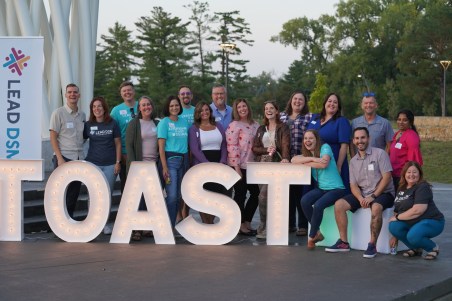
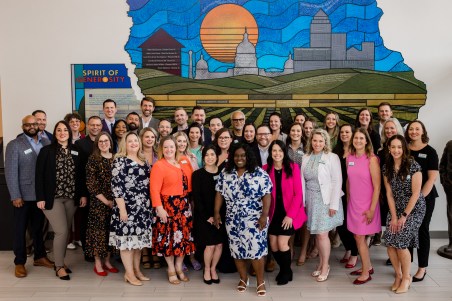
The 9-month curriculum prepares leaders from across Central Iowa to be effective stewards of our community’s future. My Class of 2024 joins more than 3,000 Lead DSM alumni, including a few of our own: Marianne Coppock, CEO (’06); Nathan Stelter, President (’13); and Estela Villanueva-Whitman, Resource Manager (’22).
“As a Leadership Institute graduate, I know the program works. It helps develop strong leaders who know how to employ creative problem-solving techniques to be successful in working towards a goal,” says Marianne Coppock, CEO. “I love it when our staff are able to participate because I know they will get so much out of it.”
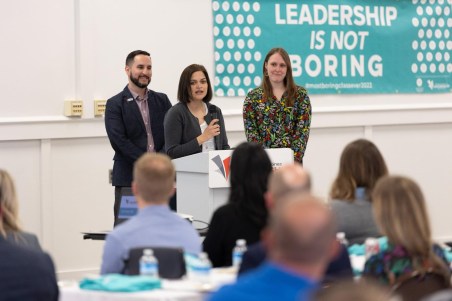
From orientation to graduation, participants work toward a final capstone project, weaving together three pillars of the program. Recent graduate, mentor and colleague Estela Villanueva-Whitman and I sat down to discuss some personal highlights from the Leadership Institute curriculum and how we’re applying them to the work we do for our nonprofit partners.
Leadership Development
Kasi: My biggest takeaways from the opening retreat were “good leaders are good humans” and “leadership development is self-development.” It’s the work that many of us are already doing, even if we don’t immediately think of ourselves as “leaders.”
We were introduced to 5 practices of exemplary leadership:
- Model the Way
- Challenge the Process
- Encourage the Heart
- Inspire a Shared Vision
- Enable Others to Act
These aren’t just business buzzwords. They represent the internal mindsets and external behaviors required to align your values and your goals.
Another takeaway for me is that “good leaders reflect.” For example, I gravitate toward “challenge the process” and “model the way”, but sometimes struggle to “inspire a shared vision”. That means when I critique the status quo or map out a marketing plan, I need to be mindful of how I’m going to bring my clients and colleagues along with me and my big ideas.
Estela: For me, “encourage the heart” really resonated. I put this into practice as a manager by listening, showing appreciation and celebrating hard work. Assigning work to our Creative and Digital teams, I show empathy and provide support because I know what it takes to produce quality work for our clients. I’ve also tried to create a spirit of community by organizing companywide volunteer and fundraising efforts.
What leadership practices come more naturally to you? What do you find more challenging?
Issues and Opportunity Awareness
Kasi: The Community Capitals Framework exposed us to critical issues within the greater Des Moines area. Each session delved into one of eight areas that together create a strong, vibrant community: Natural, Wellness, Social, Human, Financial, Built, Governance, and Cultural capitals.
Estela: These sessions, held across the metro area, were like field trips for grown-ups, allowing us to dive into each capital and learn from community stakeholders with lived experience and expertise. The session I remember the most discussed the local history of redlining—discriminatory housing policies. Although I’ve lived here for 30 years, I had no idea what it was, or its long-lasting impact. We learned about redevelopment efforts through a walking tour of Des Moines’ urban core, and it inspired me to share what I learned with friends, family and co-workers.
Kasi: At Stelter, our teams are currently organized by verticals, so we can become experts in each nonprofit sub-sector and better collaborate with our clients and each other. Throughout my sessions, particularly the Wellness capital and my capstone topic related to mental health, I was able to dig into issues relevant to my healthcare clients, giving me more empathy and insight into the challenges and opportunities they face.
Estela: As a Leadership Institute volunteer, I helped plan sessions focusing on the Human and Cultural capitals, where we toured a technical high school and historic theater and heard speakers share observations on education, workforce preparation, and how the arts create a sense of belonging. It was rewarding to hear later that a few class members had reached out to their employers to partner with one of the groups we highlighted.
What community capitals resonate most with you? What areas would you like to learn more about in your community?
Creativity for Change
Estela and I agree that our applied learning brought together a variety of concepts that help us practice leadership skills and address community needs. These also apply to our ongoing work at Stelter.
- Systems thinking reminds us that everything is connected, and progress is not always linear. This is particularly relevant when we tackle business issues, adjust workflows, and innovate with new products and services.
- Design thinking, or human-centered design, takes us through a process to empathize, define, ideate, prototype and test. We check our assumptions at the door and listen to those closest to the problem before we attempt to come up with solutions. This aligns with our discovery process in partnership with clients as we build planned giving programs together.
- Storytelling is at the heart of the human experience – and marketing, when done well! We can have an abundance of facts and figures to make our case for community progress, but we have to make people feel and understand to take action. The same goes for motivating someone to make a legacy gift.
- Ultimately, the capstone experience proved that teamwork makes the dream work. As one of my classmates joked, “I’ve never made that many decisions by committee before.” Our small groups pushed us out of our comfort zones, and even when the struggle was real, we knew we were learning and growing. (Sound familiar?)
Have you applied any of these frameworks in your work? How do you tap into your creativity to make change?
Leveling Up
Estela: Serving as a mentor helped deepen my understanding of community issues while exposing the class to new ways of thinking. The storytelling component—seeing through another’s eyes, or hearing from someone impacted—is an important step when creating meaningful solutions. It’s part of the design thinking process I continue to use when searching for work efficiencies at Stelter.
Kasi: The theme of our annual meetings and strategic initiatives at Stelter this year has been “Level Up,” and the Leadership Institute has helped me and Estela do that. I’m grateful for the opportunity, and for the company’s continued commitment to our people and the work we do in partnership with our nonprofit clients.