



What factors do you weigh when faced with a decision?
- Should you let your 16-year-old borrow the car?
- Should you loan money to a friend?
- Should you ask your colleague for help with an important project?
While there are plenty of things to consider, at the heart of them all is trust.
This holds true for donors. According to the 2024 Give.org Donor Trust Report (pdf), 67% of respondents say it is “highly important” to trust a charity before giving.
And with donors considering making a planned gift, trust likely ranks higher. Because the donor will no longer be around to see their gift realized, reinforcing that the nonprofit is trustworthy during their lifetime is critical.
Here’s some good news: Trust in charities has increased over the last five years.
Now some bad news: Trust is still low. Just 22% of study participants said they “highly trust charities.”
But let’s talk good news again. The potential to increase giving by concentrating on building trust with your donors is significant.
What Builds Donor Trust and What Holds Them Back
What makes a charity trustworthy? When asked, donors said:
- Accomplishments shared by the organization (53%)
- Third-party evaluation by an independent organization (36%)
- Financial ratios (27.5%)
- Name recognition (25%)
- Passion and sincerity in the appeal (22.5%)
When presented with scenarios that might detract them from donating, participants said they would be most discouraged when:
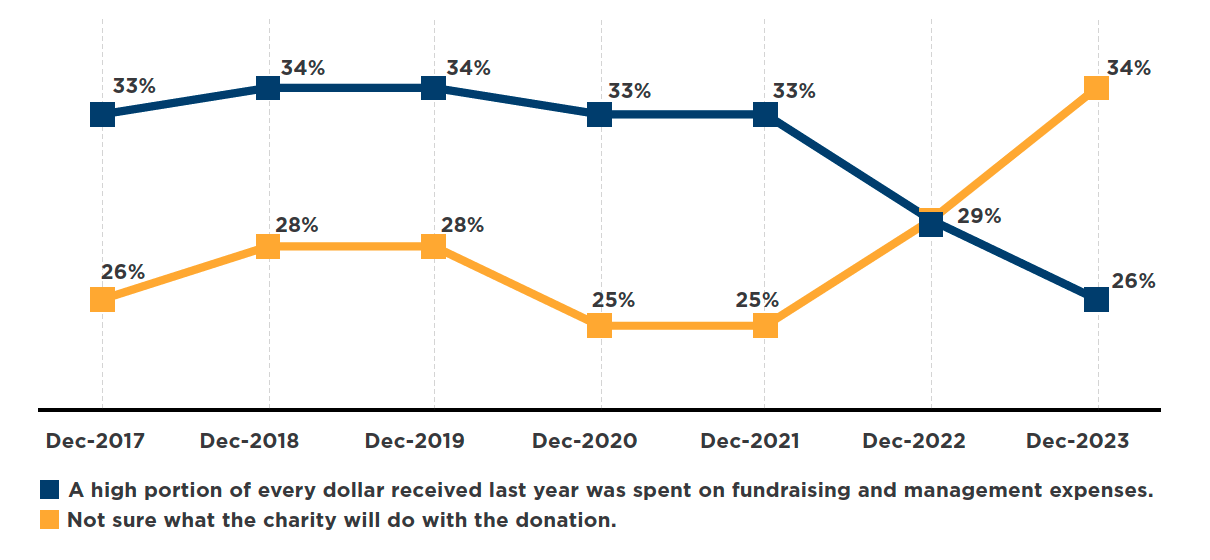
- They are not sure what the charity will do with the money they donate (34%)
- A high portion of every dollar received last year was spent on fundraising and management expenses (26%)
Although these ranked as the top two reasons given for not donating, it’s interesting to note they have trended in opposite directions over the past three years.
More participants have expressed reluctance to give when they are “not sure what the charity will do with the donation.” Meanwhile, fewer participants report being discouraged by “a high portion of every dollar received last year was spent on fundraising and management expenses.
Scenarios That Might Detract Participants From Donating, 2017-2023.
Earn Donor Trust by Delivering What They Want
So how do you earn trust? By listening and providing what they need.
- Provide regular updates on how you are fulfilling your mission—the impact you are making in your community and the services you are providing to those you support. This can be done through any of your communication channels, helping you to maintain a consistent drip of information. Posts on social media, impact stories in your newsletters, announcements on your website, or even handwritten notes will help to keep your supporters informed of the good work you do.
- Share third-party trust indicators with badges that show your nonprofit has earned a high rating/ranking from a reputable source. Make these seals of approval prominent on your website and social channels. Some to consider:
BBB Wise Giving Alliance: Give.org offers a BBB Charity Accreditation and BBB Accredited Charity Seal. To receive accreditation, nonprofits complete a questionnaire providing information on internal governance policies, financial statements and solicitation practices. Learn more about the process here.

Charity Navigator: Charity Navigator provides nonprofits with a star rating based on four “beacons”—Accountability & Finance, Leadership & Adaptability, Culture & Community, and Impact & Measurement. Review their rating methodology here.
- Ensure transparency in how your nonprofit spends money. Share your annual and quarterly reports with your supporters. Post them on your website and mail printed versions to your major donors, legacy society members and top planned giving prospects.
- Invest in your brand. Name recognition is important to the perceived trustworthiness of your organization. Develop a clear, compelling narrative about your mission and impact. Use consistent branding across all your marketing channels to reinforce recognition. Maintain an active and engaging social media presence, invest in SEO for your website, and use targeted email marketing to keep your name top of mind with donors and supporters.
- Be authentic and sincere. Write like you’re talking to a friend, using a warm and conversational tone. Avoid overly polished or corporate sounding language. Share personal stories from people impacted by your work. Let them speak in their own words through quotes, testimonials and videos to help create an emotional connection. Make donors feel valued with your sincere thanks. Speak to their impact, acknowledging their role in your mission, not just in a transaction.
Building trust with your donors is not a quick fix, but rather an ongoing effort that will result in stronger relationships and greater support. With trust as the foundation, your donors will have the confidence needed to continue to support your mission.
But wait…there’s more. The 2024 Give.org Donor Trust Report (pdf) is a treasure trove of valuable information and I recommend reading it in its entirety. But for now, I wanted to share some extra insights I thought you might find interesting
5 Extra Takeaways from the Trust Report
1. Forty-one percent of all respondents expressed being open to solicitation.
- 13% said “I would like charities to approach me more.”
- 28% said “I might be willing to give more if approached.”
2. Northeasterners are the most open to solicitation (18%). Southerners are the least (11%).
3. Northeasterners trust charities the most, while Southerners are more wary.
- Northeast: 28% | Midwest: 24% | West: 21% | South: 19%
4. Gen Z are least likely to say that trusting a charity before giving is highly important.
- Matures: 79% | Boomers: 75% | Gen X: 68% | Millennials: 64% | Gen Z: 53%
5. When asked to assess their trust across 13 nonprofit categories, participants ranked “religious organizations” most trustworthy (29%), and “educational organizations” and “arts and cultural charities” least (17% each).