


By now, you’ve likely watched the webinars and read all about the Giving USA 2024 report. (Hopefully that includes our very own Lynn Gaumer’s expert analysis!)
Do you still have questions about how all this data applies to your organization? Get answers from our Stelter strategists as they break down the report by nonprofit subsector.

In part 4 of our 4-part series, Senior Client Strategist Renee Durnin, CFRE, explores three cause-related subsectors—providing key takeaways for each.
The in-depth Giving USA 2024: The Annual Report on Philanthropy for the Year 2023 not only presents fundraising revenue metrics, but also integrates data from additional reputable studies to provide a more complete view of the current landscape for nonprofit organizations.
Our Stelter Cause Vertical team tackles legacy marketing for a spectrum of nonprofit subsectors including Religion, Human Services and International Affairs. As these three subsectors represent over 44 pages of this year’s Giving USA report, we’ve mined the report and pulled out the top five insights for each.
5 Key Takeaways on Religious Giving
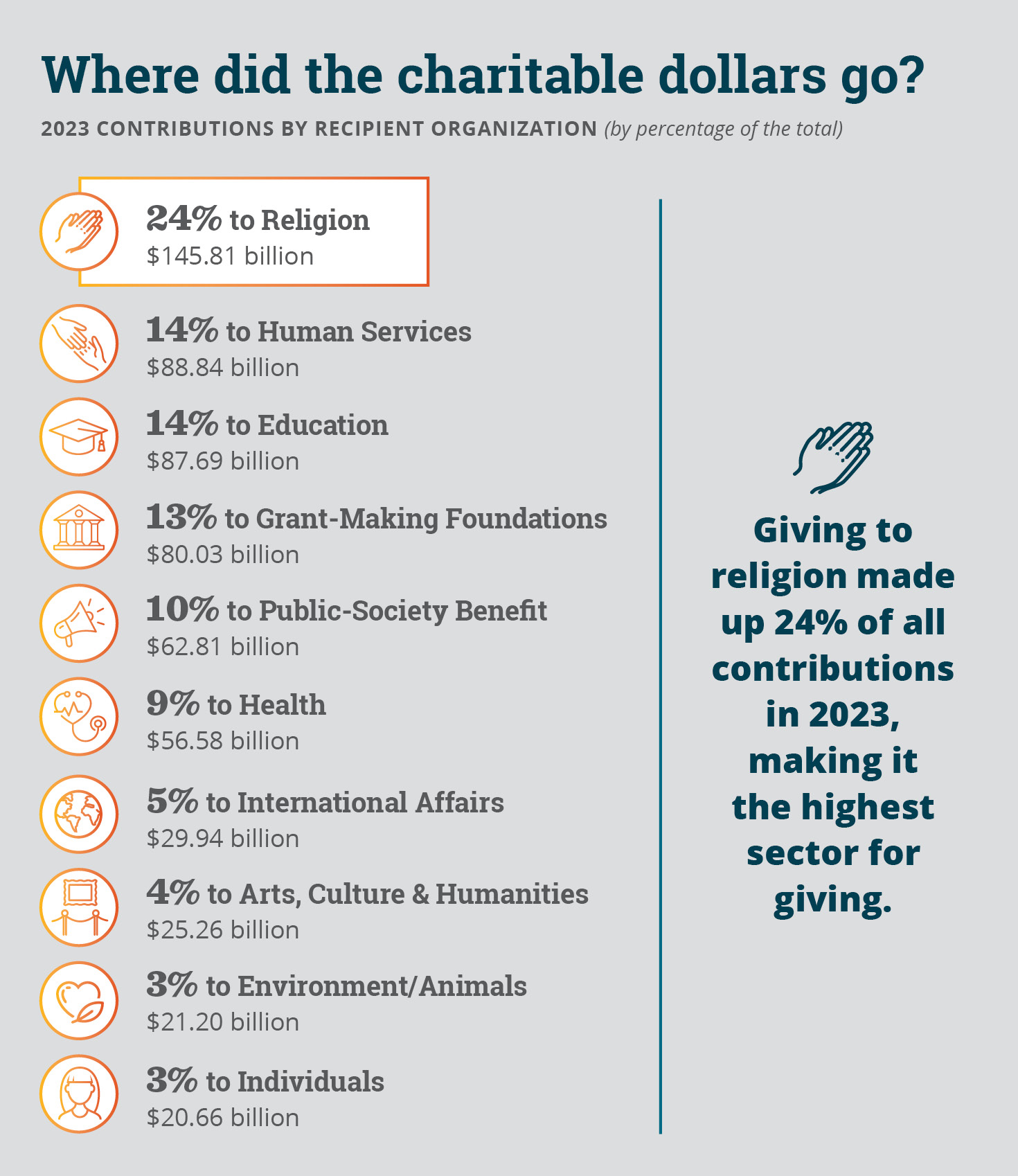
Religious giving remains a vital part of charitable donations in the U.S., making up 24% of all contributions in 2023 which is the HIGHEST sector for giving. However, despite a nominal 3.1% growth from 2022, the inflation-adjusted figure reflects a 1.0% decline, signaling challenges ahead for religious organizations.
1. The Shift to Digital Giving Is Resounding
With 60% of annual donations to congregations now coming through digital platforms, it’s clear that faith communities must embrace technology 1. From mobile apps to websites and text-to-give options, providing user-friendly and secure digital donation tools is no longer optional—it’s essential. Recurring giving options also offer stability and predictability in donor income.
2. Individual Donors Are the Backbone
A staggering 97% of faith-based individuals contributed financially, with donations, items or time in 2023 2. Furthermore, 90% of revenue for religious organizations originates from individuals, emphasizing the critical need to build and maintain relationships with congregants. Revenue from corporations and foundations is minimal, making individual giving the bedrock of religious fundraising.
3. Congregational Giving May Be Declining
Despite growth in nominal giving, religious organizations are witnessing a slow contraction in their share of overall charitable contributions. In 2011, religion accounted for 34% of all giving, dropping to 24% by 2023. While 43% of faith leaders report increased giving, another 20% see a decline3. This shrinking share suggests that religious organizations must find new ways to inspire giving as attendance and engagement wane.
4. Younger Generations Approach Giving Differently
Gen X, Millennials, and Gen Z are increasingly donating to faith-based organizations, rather than directly to houses of worship. From 2016 to 2022, faith-based organization donations grew by 130% among Millennials and 51% among Gen X4. Engaging younger generations requires a fresh approach, particularly as younger donors show less trust in religious institutions than older generations.
5. Spirituality vs. Religion
The line between spiritual and religious giving continues to blur. A Pew Research Center study shows that 70% of Americans identify as spiritual, with 48% considering themselves both religious and spiritual5. However, the percentage of Americans who identify as strictly religious or spiritual is shifting, underscoring the importance for religious organizations to appeal to a broader, more spiritually inclined audience.
In summary, religious organizations must adapt to a rapidly changing donor landscape. Digital giving is the new normal, younger generations are shaping the future of religious donations, and the gap between spirituality and religion continues to widen. By staying connected with individual donors and embracing new platforms for giving, faith-based organizations can maintain their vital roles in communities despite the broader decline in religious engagement.
5 Key Takeaways on Human Services Giving
The human services sector, which supports essential needs like food, housing, and healthcare, saw a notable increase in contributions and remains the 2nd HIGHEST sector for giving. With a changing economic and political landscape, this report reveals important trends and challenges for nonprofits in this space.

1. Human Services Donations on the Rise
In 2023, giving to human services reached $88.84 billion, accounting for 14% of total charitable contributions. Despite inflationary pressures, the sector saw a 5.8% increase in donations, and after adjusting for inflation, giving grew by 1.7%. This consistent growth reflects the sector’s resilience and donors’ prioritization of essential services like food and housing.
2. Episodic Giving Is a Challenge
Human services organizations often rely on episodic giving, driven by immediate crises like natural disasters or public health emergencies. While this attracts short-term donations, retention of these donors can be challenging. In 2023, retention rates for new donors were significantly lower than those in other sectors, indicating a need for long-term donor engagement strategies. To sustain support, nonprofits should balance immediate needs with broader, strategic goals in their communication.
3. Celebrities and Major Donors Play a Vital Role
High-profile philanthropists have made significant contributions to human services, setting a trend that has inspired broader giving. Large seven- and eight-figure donations from figures like Jeff Bezos, Oprah Winfrey and Mark Zuckerberg contributed to major relief efforts, such as those in response to the Maui wildfires. Publicizing these large gifts on social media has caused a ripple effect, encouraging smaller donors to follow suit.
4. Staffing and Resource Challenges
Nonprofits in the human services space are facing significant staffing challenges, exacerbated by rising living costs and salary competition. In 2023, nearly 67% of human services nonprofits identified budget constraints as a key issue for employee retention6. This staff shortage not only strains the organizations but also limits their ability to expand services and secure new funding opportunities.
5. Leveraging Technology and AI for Donor Engagement
Human services nonprofits are turning to AI and advanced analytics to optimize operations more often than in the past. The sector’s adoption of AI tools is helping organizations improve donor segmentation, automate communications, and analyze giving trends. This technological shift can enhance fundraising strategies, especially for smaller nonprofits, enabling them to maximize resources and improve donor retention rates.
In summary, while the human services sector continues to grow, challenges related to donor retention and staffing persist. Leveraging technology and adapting strategies to build long-term donor relationships will be crucial for continued success in this critical field.
5 Key Takeaways on International Affairs Giving
The Giving USA 2024 report shows that philanthropic giving to international affairs in 2023 decreased from 6% to 5% of overall US philanthropic dollars. From humanitarian aid to evolving donor strategies, the report highlights key trends that are shaping global giving in this sector.

1. Inflation-Adjusted Decline Despite Nominal Growth
In 2023, giving to international affairs grew by 2.5%, totaling $29.94 billion. However, when adjusted for inflation, donations declined by 1.6%. This two-year inflation-adjusted decline has reached 19.9% since 2021. Despite increased funding, inflationary pressures have eroded the real value of donations.
2. MacKenzie Scott’s Dominance in Large-Scale Donations
A significant portion of international donations in 2023 came from MacKenzie Scott. She made four large gifts, totaling $62.6 million, down from 16 large gifts totaling $143.4 million in 2022. Her continued impact highlights the influence of a few major donors in this sector.
3. Humanitarian Relief Dominates Funding
Much of the giving in international affairs is centered on disaster and humanitarian relief efforts. Significant global events like the earthquakes in Türkiye and Syria, the ongoing war in Ukraine, and the Gaza-Israel conflict drove large-scale philanthropy. Corporations and foundations also responded with donations to organizations providing immediate crisis aid.
4. Shift Toward Trust-Based Philanthropy
Donors and organizations are working to break down traditional power dynamics in global giving. Trust-based philanthropy, which empowers local organizations and minimizes donor-driven agendas, is gaining traction. This approach aims for more equitable, sustainable partnerships between funders and grantees.
5. Challenges and Opportunities in Digital Fundraising and Retaining Crisis Donors
While many international organizations see a surge in first-time donors during crises, the challenge lies in retaining them once the urgency fades. Complicating matters is a 7% decline in online fundraising revenue for international aid organizations, highlighting the need for stronger digital strategies7. To retain these donors, organizations are encouraged to invest in user-friendly digital platforms, provide ongoing impact updates, and promote recurring giving programs.
In summary, the report underscores the importance of adapting to both inflationary pressures and digital fundraising challenges. As international crises continue to dominate global giving, organizations must focus on long-term donor engagement and more equitable funding practices to ensure sustained impact.
And that’s a wrap! We hope you have enjoyed our “Closer Look” blog series on Giving USA 2024 and have come away with some actionable insights into your own nonprofit subsector.
Endnotes
- Giving in Faith: Exploring key trends in religious giving, Givelify and the Lake Institute on Faith & Giving, January 2024, https://go.givelify.com/2024_Giving_in_Faith_Report
- Same as note 1.
- Same as note 1.
- Giving by Generation: Examining the shifts in giving among donor generations, Giving USA, 2023, https://www.sneucc.org/blogdetail/17450204#:~:text=One%20noteworthy%20observation%20is%20that,are%20inclined%20to%20give%20more
- “Spirituality Among Americans,” Pew Research Center, December 2023, https://www.pewresearch.org/religion/2023/12/07/spiritualityamong-americans/
- 2023 Nonprofit Workforce Survey Results, National Council of Nonprofits, 2023, https://www.councilofnonprofits.org/files/media/documents/2023/2023-nonprofit-workforce-survey-results.pdf
- Benchmarks 2024, M+R, 2024, www.mrbenchmarks.com. Note that this study uses a convenience sample of 225 organizations and that the organization types reported in this study do not necessarily match those used in Giving USA.
[…] has steadily shrunk. By 2011, the religious sector’s share of US philanthropy had fallen to 34% (10). In the past decade this slide accelerated – by 2023, only 24% of charitable donations went to […]