


Jeremy Stelter, Stelter Executive VP, joins the blog today to take you on a walk down the four lanes of a successful planned giving marketing program.
For over two decades, I’ve traveled the country, meeting wonderful nonprofits and building their planned giving marketing programs. I’ve seen it all.
In the early 2000s, Paul Schervish’s 1999 study (predicting that over $41 trillion would be transferred over five decades from one generation to another through inheritance, philanthropy and taxes) put the giving spotlight on planned giving.
At that time, we mostly stuck to educating audiences on gift giving options. A typical annual marketing plan consisted of three to four newsletters sent roughly once a quarter and maybe a website. That was it, and it generally created enough buzz.
Flip ahead to 2024: According to USAFacts, nearly 1.5 million 501(c)(3) nonprofit organizations exist in the U.S. versus 800,000 in 1999. Obviously, there’s more competition and “noise” for donors’ attention, loyalty and legacy gifts.
The buzz is harder to hear.
Long gone are the days of sending four educational newsletters per year. We must be more balanced, more personalized and more strategic.
Today, the nonprofits that think of their marketing tactics as separate and siloed, created for one time and one purpose, will get lost in the din.
Nurturing supporters into prospects, and prospects into donors is a journey. Think of it as walking with your donors instead of simply talking to your donors.
The most successful programs use a thoughtful, balanced approach in four key lanes:
- Identification
- Education
- Conversion
- Stewardship
Here’s how I like to show clients what we mean by a “thoughtful, balanced” approach.
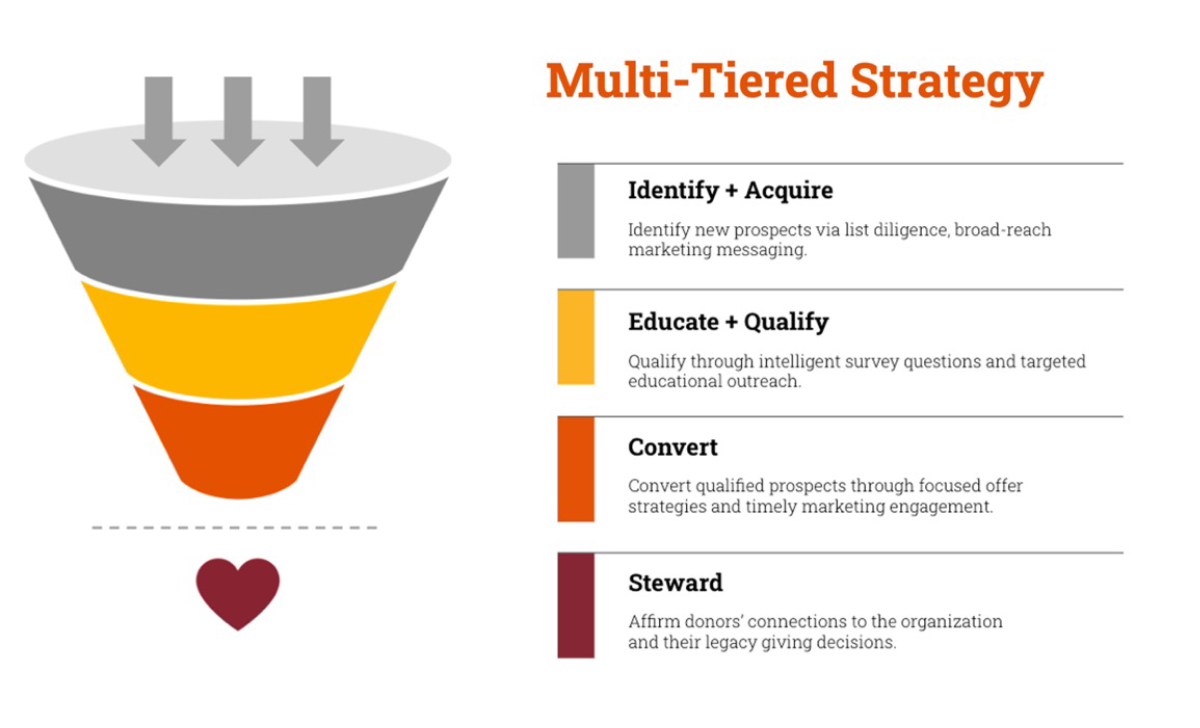
Walking Together: The 4 Lanes of a Balanced Marketing Strategy
LANE 1—Identification: Welcome
In this phase, your list is incredibly critical. I work very closely with Renee Durnin, CFRE, one of Stelter’s senior client strategists, and she is constantly reminding everyone about the “Golden Rule of Marketing.”

This is where planned giving marketing success begins.
LANE 2—Education: Baby Steps
Do you worry that you’re continually saying the same thing to the same people? While donor fatigue is a legitimate concern, consider this: Despite all our talk, only 33% of American adults have created estate planning documents. Of those that do, only 6% to 8% of Americans included a planned gift to nonprofits.
This is why continuous stream of educational content is still a critical component of a balanced marketing plan. Fortunately, over the last 20 to 25 years, we’ve scored solid 10s in educating our donors. Conversion and stewardship, the final two legs of a balanced marketing strategy, tend to fall short.
LANE 3—Conversion: The Right Direction
One of the main goals of conversion is to motivate donors to raise their hands, share their story and take the next step with their nonprofit of choice. Successful conversion campaigns focus on nurturing the relationship, addressing any concerns or questions donors may have, and are direct and focused with their ask.
Conversion marketing tactics vary but usually consist of highly personalized campaigns to targeted audiences, multiple times per year with unique asks and offers to engage donors.
(An Aside…) Using Surveys
One tool we always suggest building into conversion marketing is a donor survey. Three goals drive the use of this tool:
- Engage loyal donors
- Gather their feedback
- Give them an opportunity to declare their intentions
However, in recent years we’ve seen organizations increasingly go all in on their donor survey, making it their only marketing outreach and bypassing the critical educational component.
Doing surveys alone is a short-term solution and will not lead to long-term success.
Surveys are indeed effective tools. But they’re always better as part of a more balanced program.
LANE 4—Stewardship: Maintaining a Clear Path
Many of us are so laser-focused on conversion and education that we forget about the critical next step of stewardship.
Remember this: Bequests comprise over 90% of all planned gifts, but bequests are revocable, which makes them feel a little like, “I have good news, and I have bad news.”
The donor can change their mind at any time, and according to research by Russell James, PH.D., J.D., CFP®, two-thirds of people revise their charitable intent within five years of passing. It’s time for us to focus more on stewardship so that our education and conversion efforts are not lost.
If you look at it in the right light, stewardship is one of the best parts of our job.
You have an opportunity to make a positive donor relationship even more fulfilling—for both sides. Let’s be candid too. Stewardship also helps ensure donors’ gift intentions are actually received (aka, not revoked).
Reviewing successful stewardship campaigns Stelter has produced, three tactics stand out:
1. Cover Letter
While always a best practice, including a cover letter in your communications allows you to speak personally to your donor. It also gives you the chance to say thank you in a very direct way.
The best cover letters:
- Always personalize. “Dear friend” letters come across impersonal and dare I say, offensive, cheapening the connection you’ve worked hard to build.
- Thank donors once, twice, three times. It should be the first thing they read and the one thing that stays with them.
2. Appreciation Piece
Some ideas:
- A “gratitude report”: These reports have two objectives; to show donors how their past gifts have made an impact and to thank them for it.
- An “exclusive update” or “impact report”: For society members only—share the exciting new things happening at your organization thanks to their support. Research grants, clinical trials, educational programs, unique learning opportunities, new exhibits, a new concert series.
- A “thank you” card: Have your staff, volunteers or those who have been impacted share a simple message of thanks. Use behind-the-scenes photos for a special “inside” look.
3. Share Your Story
Without fail, the call-to-action that receives the most response from donors is when they are asked to share their story.
This can be as simple as including a reply card with space to write on or a questionnaire with prompts to help them get started. Be sure to include an email address for those who would rather send their stories digitally.
Some prompts:
- The reason I care about [ABC Organization] is:
- The first time I visited [ABC Organization], I remember:
- The word I’d use to describe [ABC Organization] is:
- The feeling I had while at [ABC Organization] was:
- My vision for [ABC Organization] for the next decade is:
- My connection to [ABC Organization] has changed my life in the following ways:
- Additional thoughts:
FINAL THOUGHT: Consistency is KEY
Over my 22-year career I have seen many start-and-stop programs. I’ve found that there is a direct correlation between consistency and planned giving success. And it’s not just consistent marketing; it’s also consistent staffing and board support.
In the spirit of the upcoming Olympics, this is a marathon, not a 100m sprint!
Go for Gold and Share Your Story
Tell us how you use the four lanes of a balanced marketing strategy to thoughtfully build and sustain your planned giving program. Any high points of success in each “lane”?